
What Do RUSF and RUTF Stand For? Key Differences Explained
What Does RUSF Stand For?
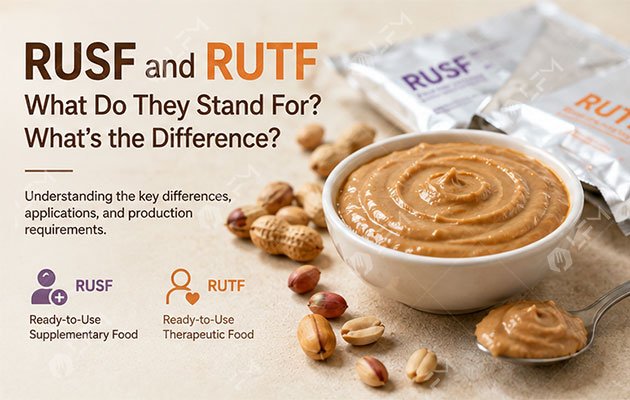
RUSF stands for Ready-to-Use Supplementary Food. It refers to a category of ready-to-eat nutritional products designed to supplement the diet of people who may not receive enough energy or nutrients from their regular food intake.
Unlike conventional foods that require cooking or preparation, RUSF products are generally designed to be consumed directly after opening. This makes them particularly practical for nutrition programs, community-based projects, emergency situations, and regions where access to cooking facilities may be limited.
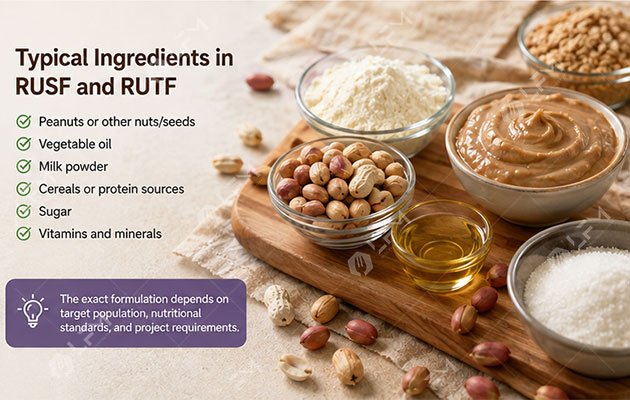
The exact formulation depends on the target population, nutritional requirements, project specifications, and local regulations. Typical ingredients may include peanuts or other nuts and seeds, vegetable oils, sugar, milk powder, cereal ingredients, protein sources, and vitamin and mineral premixes.
For companies considering entering the RUSF market, the challenge is therefore not simply selecting a mixing machine. Raw material processing, formulation accuracy, product consistency, packaging, and quality management all need to be considered as part of the complete production concept.
What Does RUTF Stand For?
RUTF stands for Ready-to-Use Therapeutic Food. It is a specialized ready-to-eat food generally associated with nutrition intervention programs, particularly those addressing severe acute malnutrition.
RUTF products are typically formulated to provide high energy and nutrient density in a convenient, ready-to-consume form. Common formulations may contain peanut paste, milk powder, vegetable oil, sugar, vitamins, and minerals, although the exact recipe depends on applicable standards and project requirements.
Because of its specific nutritional and intervention-oriented purpose, RUTF production requires careful control of ingredients, processing conditions, hygiene, product consistency, and finished-product quality.
For manufacturers, this means that an RUTF project should be approached as an integrated food-processing system rather than simply a collection of individual machines.
What Are the Main Differences Between RUSF and RUTF?
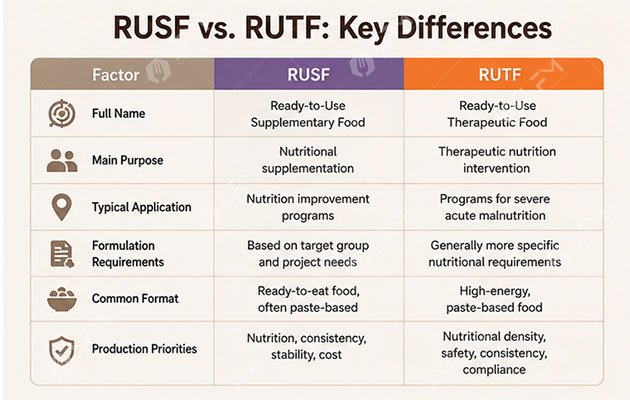
RUSF and RUTF share several similarities. Both are ready-to-use nutritional foods, and some of their raw materials and processing technologies can overlap. However, their intended applications are different.
| Factor | RUSF | RUTF |
|---|---|---|
| Full name | Ready-to-Use Supplementary Food | Ready-to-Use Therapeutic Food |
| Main purpose | Nutritional supplementation | Therapeutic nutrition intervention |
| Typical application | Nutrition improvement and supplementary feeding programs | Specific interventions for severe acute malnutrition |
| Formulation | Determined by target users and project requirements | Generally subject to more specific nutritional requirements |
| Common format | Ready-to-eat nutritional food, often paste-based | Commonly a high-energy, ready-to-eat paste |
| Production priorities | Nutrition, consistency, stability, cost efficiency | Nutritional density, safety, consistency, and compliance |
The exact formulation and production specifications should always be determined according to the requirements of the target market, customer, project, and applicable regulations.
Why Nut Processing Matters for RUSF and RUTF
Many RUSF and RUTF formulations rely on peanuts, nuts, or seed-based ingredients. As a result, the quality of upstream raw material processing can have a direct impact on the final product.
Peanuts and other nuts may require cleaning, sorting, roasting, cooling, peeling, grinding, and storage before they enter the main formulation process. Consistency at this stage can influence paste texture, flavor, oil distribution, temperature, and downstream mixing performance.
This is why companies planning a commercial RUSF or RUTF project should evaluate the entire processing chain rather than focus only on the final mixing or filling equipment.
LFM is a digital food processing solutions provider specializing in nut, cocoa, and chocolate processing. Its experience in nut-processing technologies can be particularly relevant when a project involves peanut or other nut-based ingredients and requires coordinated upstream processing.
How Should You Plan an RUSF or RUTF Production Line?
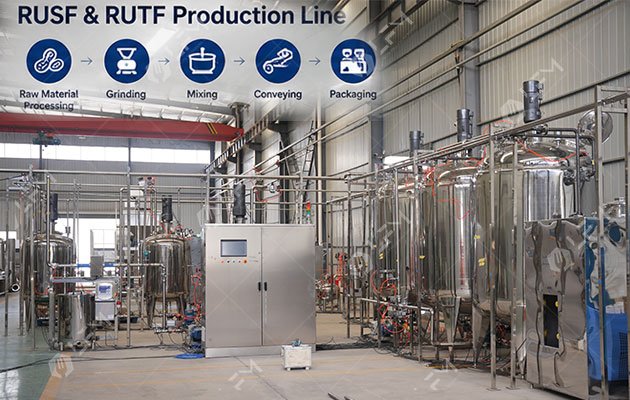
Companies looking for a broader overview can also explore an RUTF and RUSF production line concept to understand how raw material processing, grinding, mixing, conveying, and packaging can be integrated into one coordinated process.
What Should You Look for in an Equipment Supplier?
Equipment price is only one part of a successful RUSF or RUTF project. A capable supplier should understand the relationship between raw materials, formulation, processing parameters, production capacity, and the final product.
For nut-based formulations, factors such as grinding fineness, throughput stability, temperature management, cleaning requirements, and coordination between processing stages can all affect production performance.
It is also important to consider scale-up. A formulation that works at laboratory or pilot scale may require different equipment parameters when transferred to industrial production. Working with a technical supplier during the early planning stage can therefore help manufacturers reduce equipment-matching risks and build a more practical production system.
How Can LFM Support Your Project?
LFM focuses on digital food processing solutions for nut, cocoa, and chocolate processing. When an RUSF or RUTF project involves nut-based raw materials, its technical capabilities can be considered as part of the upstream processing and overall production planning process.
Manufacturers preparing to build a new facility, upgrade an existing plant, or evaluate equipment options can provide information such as the product formulation, target capacity, raw materials, packaging format, and target market. These details provide a useful basis for evaluating the appropriate equipment configuration and production workflow.
Final Takeaway
In simple terms, RUSF is primarily designed for nutritional supplementation, while RUTF is intended for specific therapeutic nutrition interventions. Although the two products may share certain ingredients and processing technologies, their applications, formulation requirements, and quality considerations can be significantly different.
For businesses evaluating an RUSF or RUTF project, selecting equipment based only on purchase price can create unnecessary challenges later. A better approach is to consider raw material preparation, processing technology, production capacity, automation, quality control, and future expansion as one complete system.
If you are looking for equipment for RUSF/RUTF projects or require solutions tailored to specific production capacities, please contact LFM to obtain a technical proposal and quotation suited to your project.
Message