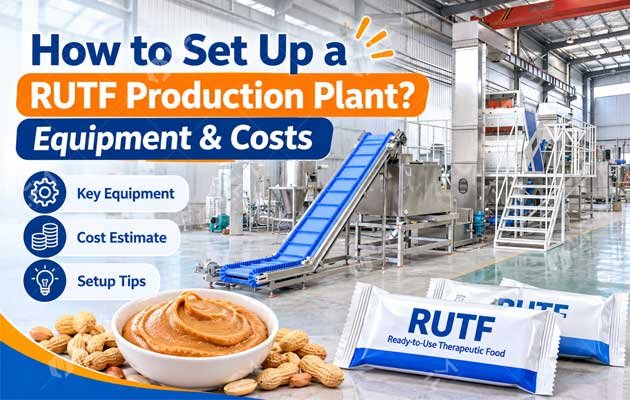
Setting up a Ready-to-Use Therapeutic Food (RUTF) plant is more than just buying food processing machinery. You've got to consider raw material supply, formulation requirements, production capacity, processing technology, food safety management, factory layout and packaging before you even start.
As demand for the specialist nutrition products continues to create opportunity for local manufacture, having an efficient production facility in place can go a long way to enabling a business to build a reliable supply chain and serve the regional market.
For anyone looking at investing in or setting up a food manufacturing operation in this area, it's vital to understand the key stages involved in a RUTF production plant project. This guide walks you through the process of planning your plant, the equipment you'll need to process the RUTF, how you'll organise your production, and how you put together a production line to meet your own business needs.
1. Define Your RUTF Product and Production Requirements
The first step in selecting machinery is to work out what type of therapeutic food you intend to make.
RUTF is a high energy, nutrient dense food for the management of severe acute malnutrition. It's generally available as a ready to eat paste in individual sachets (no cooking, no water required).
According to the WHO guideline on the prevention and management of wasting and nutritional oedema, therapeutic food plays an important role in the dietary management of children with severe acute malnutrition. Manufacturers should ensure that product formulation and nutritional specifications are developed in accordance with applicable international guidelines and local regulatory requirements.
Traditional formulations commonly contain ingredients such as:
Peanut paste or other approved legume-based ingredients
Milk powder or alternative protein sources
Vegetable oil
Sugar
Vitamin and mineral premixes
Other permitted ingredients depending on the formulation
The precise ingredient mix will of course depend on the target product specification and the relevant regulatory requirements.
At the planning stage, manufacturers should clarify several important factors:
Product formulation: Work with experienced food formulation specialists to define the required nutritional profile, ingredient specification, texture and product characteristics.
Production capacity: Work out the required daily or hourly output based on market demand, operating hours and future expansion plans.
Packaging format: Will the finished product be packed in individual sachets, tubes or other approved packaging formats?
Target market: Where are we going to manufacture and distribute the product? The regulatory regime and customer requirements may be very different in different countries.
These decisions will have a direct bearing on the equipment configuration and the total investment required.
2. Choose the Right RUTF Production Capacity
Production capacity is one of the key issues when setting up a new factory.
A line that's too small may find it difficult to cope with future orders, whereas too much initial capacity will obviously lead to higher equipment costs and higher operating costs.
Before choosing a capacity, evaluate:
Expected market demand and purchasing contracts
Available raw material supply
Planned daily production hours
Number of production shifts
Packaging speed and finished product storage capacity
Potential expansion requirements
For instance a manufacturer serving a regional market might well start with a fairly modest sized processing plant. A business in the market for large institutional contracts on the other hand is likely to require a much higher capacity automated production system.
It's also important to separate out the processing capacity of individual machines from the actual output of the whole production line. The grinding, mixing, homogenising and filling equipment all have to be running at compatible speeds otherwise you'll end up with a production bottleneck.
A properly configured RUTF production line should therefore be designed around the required finished product output rather than the capacity of a single machine.
3. Select the Essential RUTF Processing Equipment
Equipment selection has a direct bearing on how efficiently the raw materials are converted into a consistent finished product.
Although the exact configuration will vary depending on the formulation and the manufacturing process, a peanut based RUTF facility may consist of the following equipment sections.
Raw Material Cleaning and Preparation
The process starts with inspection and preparation of the incoming raw materials.
For the peanut based formulations, the cleaning of the equipment will remove stones, dust and the like prior to further processing. Magnetic separators and metal detectors can provide an extra layer of protection against the presence of metal.
Raw material preparation may also involve sorting and grading equipment (depending on the ingredients being used of course).
Peanut Roasting and Grinding
Peanuts generally need to be appropriately thermally treated prior to being made into paste.
An industrial peanut roasting machine provides the controlled heating as per the validated process. After roasting and appropriate cooling/handling the skins can be removed by a peeling machine if required.
The prepared peanuts are then fed into the peanut grinder.
The grinding system will reduce the particle size and produce a smooth peanut paste which is then suitable for formulation and mixing. The equipment selection will be based on required grinding fineness, temperature control, processing capacity and the required final texture.
Ingredient Mixing and Homogenization
This section combines the peanut paste with the other ingredients as per the approved formulation.
An industrial mixing machine will mix the ingredients through the product to give a uniform mixture. The system will be capable of handling oils, powders and micronutrient premixes depending on the formulation.
A homogeniser or fine grinding system may be incorporated to improve product uniformity and texture. The equipment should be selected on the basis of the required particle size, viscosity and product characteristics. These have to be validated by product testing rather than simply assumed from the equipment specification.
Filling and Packaging
Once the product has passed the requisite processing and quality checks it moves into the filling section.
A suitable automatic filling and sealing machine can dispense the pre-prepared paste into individual sachets with the correct filling quantities.
When selecting packaging equipment, manufacturers should evaluate:
Sachet dimensions and packaging material compatibility
Filling accuracy and production speed
Sealing strength and package integrity
Product handling and contamination prevention
Coding, batch identification, and traceability
Packaging performance is absolutely critical as the RUTF products will need to survive transport and storage in a variety of difficult distribution environments.
4. Plan the Factory Layout and Production Workflow
A well designed facility will facilitate the movement of materials, people and finished goods.
Rather than just laying the machines out according to the available floor space, the layout should be designed around the production sequence and the hygiene requirements.
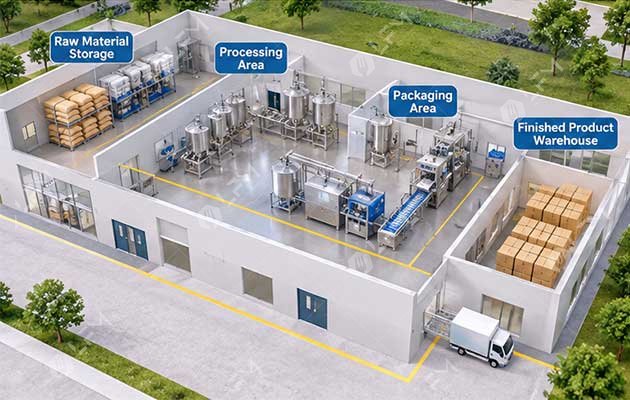
A typical facility may include the following functional areas:
Raw material receiving and storage: An area for receiving, inspecting and storing the ingredients under appropriate conditions.
Pre-processing area: space for cleaning, sorting, roasting, cooling and grinding.
Ingredient preparation and mixing area: A dedicated area for weighing, preparing and blending of the ingredients.
Processing and filling area: A controlled production area for further processing and product packaging.
Finished product warehouse: A separate warehouse area for packaged products awaiting inspection, release and distribution.
The site should also have appropriate personnel access, cleaning facilities, utility connections, ventilation, drainage (where required) and maintenance space.
Particular care must be taken to prevent cross contamination between the raw materials and the finished product.
For low moisture foods (i.e. conventional RUTF paste) moisture control and hygienic zoning are key considerations. The equipment surfaces, transfer systems and the filling environment itself need to be designed to facilitate effective cleaning and hygiene.
5. Establish Food Safety and Quality Control Systems
Food safety is absolutely a prerequisite for any RUTF manufacturing operation.
Buying the right piece of kit in itself won't guarantee that the end product meets the nutritional and microbiological specifications. You need a full quality management system in place covering the ingredients, the processing, the people and the finished product.
Important areas include:
Raw material inspection: check supplier qualification, ingredient specification and incoming material quality.
Process monitoring: Put in place operating procedures and monitor the relevant process parameters (temperature, mixing, product handling etc).
Microbiological testing: Establish an appropriate testing programme for raw materials, the production environment and the finished product.
Foreign material control: Use appropriate inspection and detection systems to minimise the risk of physical contamination.
Packaging integrity: Check the sealing and the package performance to protect the finished product.
Batch traceability: maintain the production records, ingredient batch info and inspection results to support quality investigations and product tracking.
It is also important to work with qualified food scientists and laboratories to validate the formulation, manufacturing process, and finished-product quality.
6. Estimate the Investment and Operating Costs
The investment required to establish a manufacturing facility depends on several factors. There is no single standard price for every project because equipment configurations, production capacities, factory conditions, and regulatory requirements can vary significantly.
The main cost categories generally include:
Investment Category
Main Cost Considerations
Processing machinery
Cleaning, roasting, grinding, mixing, homogenization, and filling equipment
Factory construction
Building, flooring, hygienic zoning, and facility improvements
Utilities
Electricity, water, compressed air, ventilation, and other services
Packaging materials
Sachets, cartons, labels, and related consumables
Quality control
Testing instruments, laboratory services, and inspection systems
Installation
Equipment transportation, installation, commissioning, and training
Operating expenses
Raw materials, labor, maintenance, and energy consumption
To obtain a realistic project budget, manufacturers should prepare an equipment list and define their production requirements before requesting quotations.
Comparing suppliers only by the initial machinery price may result in an incomplete investment assessment. It is equally important to evaluate equipment compatibility, automation level, technical support, spare parts availability, and long-term operating costs.
Selecting the right equipment supplier can have a massive bearing on the success of a new manufacturing project.
A competent supplier should be able to understand what the product is, be able to recommend an appropriate processing configuration and be able to co-ordinate the machinery to achieve the required production output.
Before making a purchasing decision, consider the following factors:
Industry experience: Does the supplier have any experience in peanut processing, paste production or the manufacture of specialist food equipment?
Complete equipment configuration: Can the supplier provide a fully integrated system incorporating cleaning, roasting, grinding, mixing and packaging?
Customization capability:Can the line be customised to the formulation, factory space and required capacity?
Automation and control: Does the system enable centralised operation and monitoring of the key production parameters?
Installation and commissioning: Can the supplier provide technical assistance during installation and equipment testing?
After sales support: Are the operating instructions, maintenance guidance, spares and technical support available?
It's also worth asking for equipment specs, processing videos, reference projects and a full technical proposal prior to purchase.
For a business looking to build a new site, working with a supplier who has a full understanding of the complete production flow will help with the co-ordination of equipment and reduce the integration issues.
8. Build Your RUTF Manufacturing Facility with a Complete Production Solution
A successful manufacturing facility has to have co-ordination between product formulation, raw material prep, processing equipment, packaging technology and quality.
A bespoke production solution can help the manufacturer to integrate those various operations into a more efficient workflow.
For any business looking at manufacturing peanut based therapeutic foods our Complete RUTF and RUSF Solution provides an equipment configuration which covers the key stages of the process from raw material prep and peanut processing through to paste making and final packaging.
The system can be configured to suit different production capacities, product requirements and factory conditions. The layout of the equipment will vary from project to project and may incorporate cleaning, roasting, grinding, mixing and packaging equipment.
Rather than selecting individual machines, the manufacturer can work with our technical team to put together an integrated processing plan based on their output and their production requirements.
If you're setting up a new site or upgrading an existing food processing operation, let us know your required capacity, product formulation and packaging. We can then look at the equipment configuration you'll need and put forward a production line solution.
Contact us today to discuss your RUTF manufacturing project and explore a customized production solution.