
Tiger Nut Butter Processing Process: Complete Guide
Tiger nut butter is gaining attention in the food processing industry as a plant-based spread made from nutrient-rich tiger nuts. With its naturally sweet, nutty flavor and creamy texture, tiger nut butter can be used in spreads, bakery fillings, snack products, and other food applications.
For food manufacturers planning to enter this market, understanding the tiger nut butter processing process is essential. From raw material cleaning and roasting to grinding, refining, and vacuum deaeration, each processing stage affects the final product's flavor, texture, quality, and production efficiency.
This guide explains the complete industrial processing workflow, the main equipment involved, and important factors to consider when establishing an industrial tiger nut butter production facility.
1. What Is the Tiger Nut Butter Processing Process?
The tiger nut butter processing process involves transforming cleaned and prepared tiger nuts into a smooth, homogeneous paste through a series of mechanical and thermal treatments.
Unlike small-scale homemade production, industrial processing requires integrated equipment to ensure consistent product quality, stable operation, and efficient material handling.
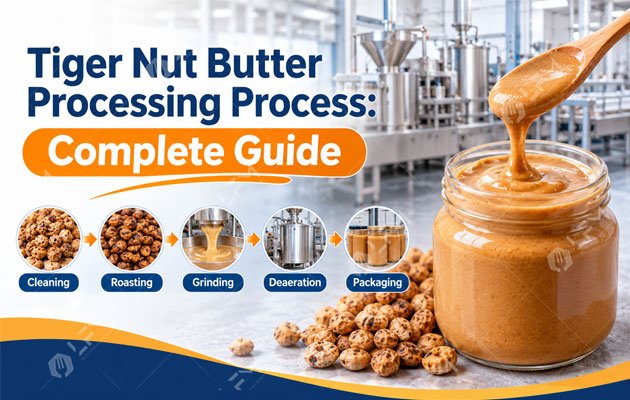
A typical industrial processing workflow includes:
- Raw tiger nut cleaning
- Destoning and metal detection
- Roasting
- Cooling and sorting
- Primary grinding
- Secondary grinding and refining
- Vacuum deaeration
- Storage and filling
The exact configuration can be adjusted according to raw material characteristics, target product texture, processing capacity, and the manufacturer's requirements.
2. Step-by-Step Tiger Nut Butter Processing Process
Step 1: Raw Tiger Nut Cleaning
The first step is removing impurities from incoming tiger nuts.
Raw materials may contain dust, soil, plant residues, small stones, and other foreign materials collected during harvesting, transportation, and storage.
A vibrating cleaning screen or other suitable cleaning equipment separates larger and smaller impurities from the raw materials.
Proper cleaning helps protect downstream machinery and improves the hygiene of the final product.
Step 2: Destoning and Metal Detection
After initial cleaning, tiger nuts pass through destoning equipment to remove stones and other heavy impurities.
Metal detection or magnetic separation is then used to identify and remove metallic contaminants, depending on the production line configuration.
This stage helps protect grinding equipment from damage and supports food safety management throughout the production process.
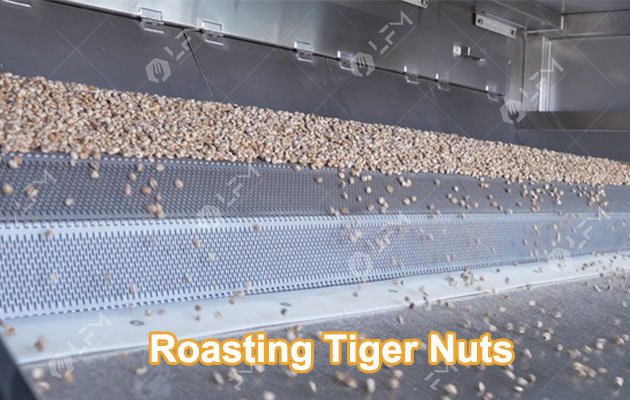
Step 3: Tiger Nut Roasting
Roasting is one of the most important stages in the tiger nut butter processing process.
During roasting, controlled heat treatment helps develop the characteristic roasted aroma and flavor of tiger nuts. It also influences moisture content, texture, and subsequent grinding performance.
Industrial roasting equipment can be configured with adjustable temperature, processing time, and conveying speed to accommodate different raw material conditions.
Key factors to control include:
- Roasting temperature
- Roasting time
- Initial moisture content
- Heating uniformity
- Discharge temperature
Over-roasting may result in undesirable flavors, while insufficient roasting may affect the final taste and processing characteristics.
Therefore, roasting parameters should be established through production trials based on the specific tiger nut variety and desired product profile.
Step 4: Cooling and Color Sorting
After roasting, tiger nuts need to be cooled to an appropriate temperature before further processing.
A cooling conveyor or cooling system helps reduce product temperature and prevents excessive residual heat from affecting subsequent grinding.
Color sorting can also be incorporated to remove discolored, burnt, or defective tiger nuts.
This stage helps improve raw material consistency and supports the production of tiger nut butter with a more uniform appearance and flavor.
Step 5: Primary Grinding
The roasted tiger nuts are transferred to a primary grinding machine, where they are crushed into a coarse paste.
During grinding, mechanical force breaks down the tiger nut structure and releases its natural oils, gradually forming a thick paste.
The grinding fineness at this stage depends on the equipment design, material characteristics, and required production capacity.
Stable feeding and appropriate grinding parameters are important for maintaining continuous operation and reducing unnecessary equipment load.
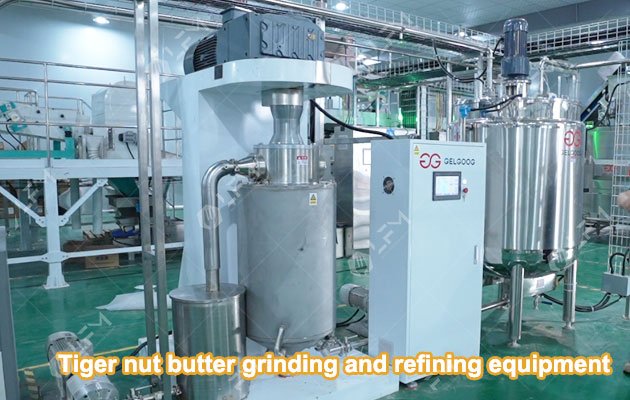
Step 6: Secondary Grinding and Refining
After primary grinding, the coarse paste undergoes further grinding and refining to achieve the desired consistency.
A colloid mill or other suitable fine-grinding equipment can be used to reduce particle size and improve product smoothness.
Depending on the final product requirements, manufacturers may use multiple grinding stages to obtain a finer and more homogeneous texture.
Important factors include:
- Grinding fineness
- Equipment gap and operating speed
- Material temperature
- Feed rate
- Paste viscosity
The final texture should be determined according to the intended application, whether it is a spreadable butter, a bakery filling, or an ingredient for further food manufacturing.
Step 7: Vacuum Deaeration
Grinding and material transfer may introduce air into the paste. Excessive air can affect product appearance, filling accuracy, and storage stability.
Vacuum deaeration removes entrapped air from the tiger nut paste under controlled vacuum conditions.
This process helps reduce air bubbles, improve product density, and create a more uniform finished texture.
The vacuum level and processing conditions should be adjusted according to the paste's viscosity and production requirements.
Step 8: Storage and Filling
After processing, the finished tiger nut butter can be transferred to a temporary storage tank before packaging.
A suitable filling system can then dispense the paste into jars, bottles, buckets, or other food-grade containers.
Filling capacity, packaging specifications, and product viscosity should all be considered when selecting the packaging equipment.
For industrial production, automated transfer and filling systems can reduce manual handling and improve packaging efficiency.
3. Main Equipment Used in Tiger Nut Butter Processing
A complete tiger nut butter processing system consists of several interconnected machines. Each unit performs a specific function, and the equipment configuration should match the required production capacity and final product specifications.
| Processing Stage | Main Equipment | Main Function |
|---|---|---|
| Cleaning | Vibrating cleaning screen | Removes dust and impurities |
| Destoning | Destoner | Separates stones and heavy contaminants |
| Metal Separation | Magnetic separator / metal detector | Removes or detects metallic contaminants |
| Roasting | Industrial tiger nut roaster | Develops flavor and controls moisture |
| Cooling | Cooling conveyor | Reduces material temperature |
| Sorting | Color sorter | Removes defective materials |
| Primary Grinding | Coarse grinding machine | Converts roasted tiger nuts into paste |
| Fine Grinding | Colloid mill / refining equipment | Improves paste fineness and smoothness |
| Deaeration | Vacuum deaeration tank | Removes entrapped air |
| Packaging | Automatic filling machine | Fills finished butter into containers |
For manufacturers looking to establish an integrated facility, selecting compatible equipment is just as important as choosing individual machines.
LFM provides customized Tiger Nut Butter Production Line solutions, with equipment configurations designed around raw material conditions, processing capacity, and finished product requirements.
4. Key Factors Affecting Tiger Nut Butter Quality
Producing high-quality tiger nut butter requires more than simply grinding the raw material. Several processing parameters directly influence the final product.
4.1 Raw Material Quality
The quality of incoming tiger nuts affects the flavor, color, and processing performance of the finished butter.
Manufacturers should pay attention to raw material freshness, moisture content, cleanliness, and storage conditions.
4.2 Roasting Temperature and Time
Roasting conditions determine the development of roasted flavor and influence the subsequent grinding process.
A stable heating system and adjustable roasting parameters help manufacturers achieve consistent results between production batches.
4.3 Grinding Fineness
Grinding fineness is closely related to the smoothness and mouthfeel of tiger nut butter.
Different applications may require different particle sizes. Manufacturers should select grinding equipment and operating parameters based on their target product specifications.
4.4 Temperature Control During Grinding
Grinding generates heat through mechanical friction. Excessive temperature increases may affect product characteristics, especially when processing heat-sensitive ingredients.
Appropriate equipment selection and temperature management help maintain stable processing conditions.
4.5 Hygiene and Process Control
Food-contact surfaces should be made of suitable food-grade materials and designed for effective cleaning.
A well-organized production line also helps reduce unnecessary manual handling, improve process consistency, and support food safety management.
6. How to Choose the Right Tiger Nut Butter Processing Equipment?
Before investing in a industrial processing system, manufacturers should evaluate several important factors.
- Production capacity: Determine the required hourly or daily output.
- Finished product requirements: Define the desired smoothness, viscosity, color, and flavor.
- Raw material conditions: Consider the variety, moisture content, and initial quality of tiger nuts.
- Automation level: Decide whether manual, semi-automatic, or fully automatic processing is required.
- Factory layout: Ensure sufficient space for equipment installation, material movement, and maintenance.
- Packaging requirements: Select filling equipment according to container types and packaging capacity.
It is also important to discuss the complete processing workflow with an experienced equipment supplier before finalizing the production line configuration.
7. Customized Tiger Nut Butter Processing Solutions by LFM
LFM provides food processing machinery and customized production solutions for manufacturers seeking to establish or upgrade their tiger nut butter processing facilities.
Rather than offering a fixed equipment combination for every customer, LFM can configure processing systems according to specific production requirements.
A customized solution may include:
- Raw material cleaning and impurity removal
- Destoning and metal detection
- Intelligent roasting and cooling
- Color sorting
- Primary and secondary grinding
- Vacuum deaeration
- Finished product transfer and filling
For example, LFM has completed a 1-ton-per-hour tiger nut butter production project in China. The integrated system combines multiple processing stages with centralized PLC control.
Operators can monitor key production parameters, including temperature, operating speed, material flow, weighing data, and conveying rhythm through the central control system.
For manufacturers planning to build a industrial tiger nut butter processing facility, LFM can provide equipment selection, process design, and customized production line solutions.
Contact LFM to discuss your tiger nut butter processing requirements and receive a customized equipment proposal.
Message